

Reading time
4
min
How the Scrum methodology is used in app development
Many people who work with agile methodology wonder whether a team can work well in Scrum without needing a Scrum Master. After all, it’s a hard role to fill, even though it gets a lot of attention.
A Scrum Master is, basically, the coach of an agile team—aligning and organizing all stages of a project.
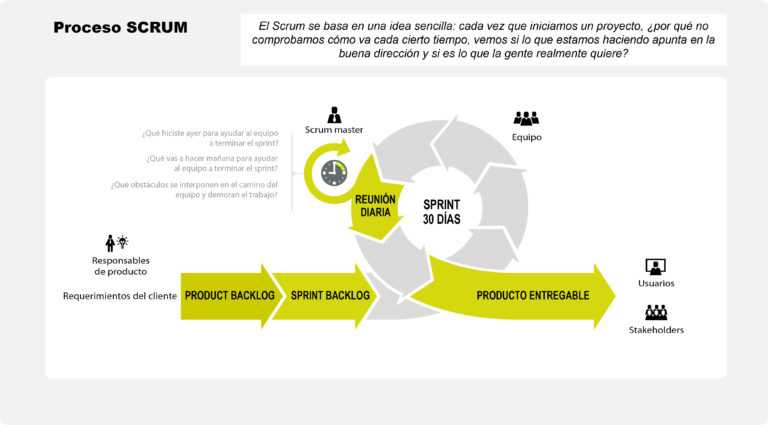
Among the many responsibilities of a Scrum Master are:
In addition, this person acts as a true team leader, protecting the team from external influences and making sure everyone stays focused on the final objective. The Scrum Master is the one who takes on responsibilities and risks on behalf of the team.
With so many roles—organizing work, coaching principles and practices of agile methodology for anyone who joins the process—the question remains:
Actually, yes. Or at least, it should be possible.
A team focused on agile methodology should be able to self-organize and manage itself, since the steps in Scrum complement each other and require the focus of multiple people.
So whenever an agile team runs into doubts within a project, it should be able to discuss solutions among people from complementary stages, making the “machine” run on its own.
It works more or less like this: if person C detects a problem in their stage, they can try to resolve the obstacle with person B, who is responsible for delivering the previous stage, or with person D, who will pick it up next.
However, a team that is completely new to the methodology shouldn’t try to follow the process without a Scrum Master. Simply reading a book on the topic won’t make anyone a specialist, and building the process correctly takes time.
Teams need to follow rules and ceremonies that should be led by someone who understands what they’re doing, since a “looser” approach can lead to breaking many rules. And once distorted, an agile methodology may not be agile at all.
Su‑Ha‑Ri is a technical term, popularized by Akito and Alistair Cockburn, that describes how Scrum principles tend to work in practice.
In this concept, “Su” is the initial stage, when you don’t know much about the technique and need intensive training to learn what Scrum is, how it works, and what its benefits are. For many practitioners, it’s only after this training that a Scrum Master can say they are ready to lead a project.
For this first step to work, you must stick to the rules and avoid making decisions based on guesswork. There’s also no room in Scrum to change rules based on convenience. That not only breaks the process but can also “traumatize” team members, who may never fully engage with agile methods after a disastrous experience.
“Ha” is when you learn to become a Scrum Master by observing other leaders, turning everything you now know into day‑to‑day practice.
And “Ri” is when you’re so accustomed to Scrum that you can finally try breaking rules without causing disasters or turmoil. One of those rules is that you may eventually give up the Scrum Master role during the process, trusting the team 100% to deliver quality projects on time.
In short: yes, you can have Scrum without a Scrum Master, as long as it’s not your first attempt at implementing the method. Let the team get comfortable with the leader role and understand the rules thoroughly before taking it out of the game.
After all, even if the Scrum Master role no longer exists in your team, that doesn’t mean that, as the team self‑organizes, it can’t—or won’t—choose a leader on its own. And if that’s the path, it’s best that everyone is prepared to assume, even indirectly, that role.


